
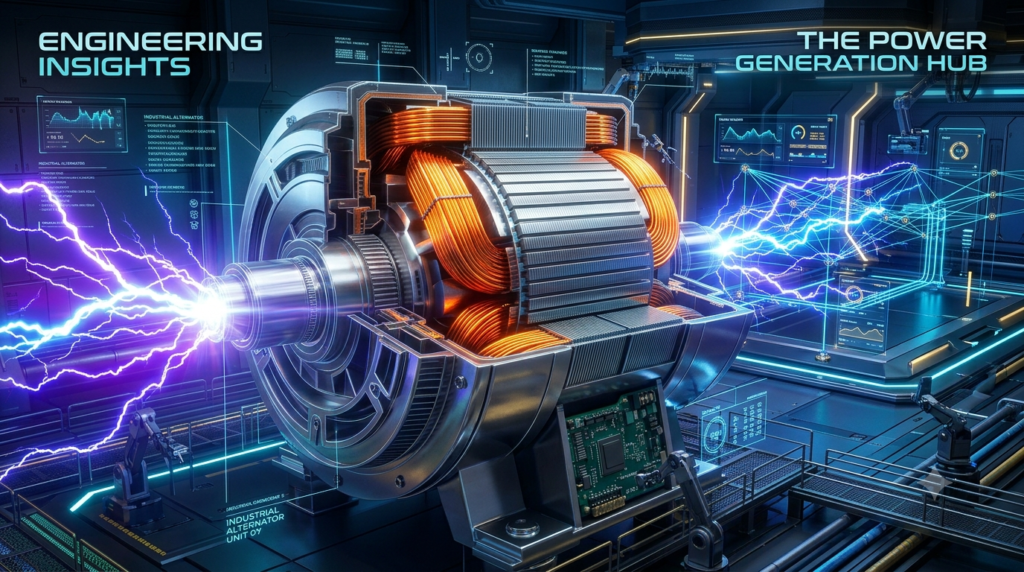
CHAPTER 1: THE GENESIS OF ELECTRICITY & AC Generator & Alternator
1.1 The Amber Effect and Static Observation (600 BCE)
AC Generator & Alternator ka safar kisi modern lab mein nahi, balki samundar ke kinare mile ek pathar jaise material se shuru hua tha. Iske alawa, 600 BCE mein Greek philosopher Thales of Miletus ne ek ajeeb observation ki thi. Unhone dekha ki jab Amber ko billi ki khaal par ragada jata hai, toh uske andar ek aisi magnetic taqat aa jaati hai jo halke tinke aur pashuon ke baal apni taraf attract karne lagti hai.

Engineering perspective se samjhein toh yeh insaniyat ka pehla encounter tha Triboelectric Effect (Static Electricity) se. Jab do alag materials aapas mein rub hote hain, toh unke electron affinity ke difference ki wajah se ek material se electrons nikal kar doosre par chale jaate hain. Iske karan ek electrostatic field paida hoti hai. Lekin unke paas is charge ko store karne ya move karne ka koi raasta nahi tha. Isliye hazaron saal tak yeh sirf ek jaadu ya khilona ban kar reh gaya.
1.2 William Gilbert and the Coining of “Electricus” (1600)
Lagbhag 2200 saal tak is field mein koi bada breakthrough nahi hua. Fir saal 1600 mein Queen Elizabeth I ke personal physician William Gilbert ne ek revolutionary kitaab likhi—“De Magnete”.
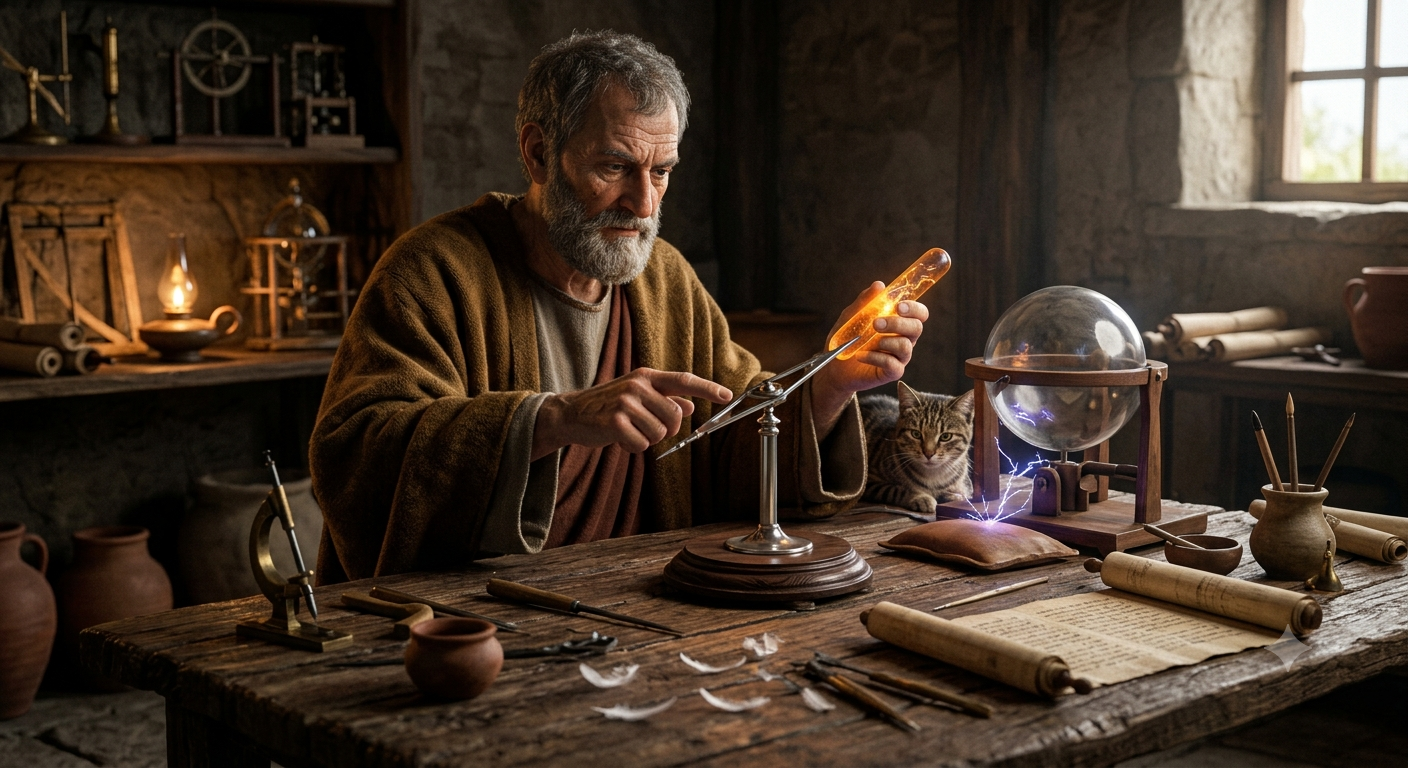
Gilbert ne pehli baar static attraction aur magnetic attraction ke beech ka difference clear kiya. Unhone bataya ki magnet sirf iron ko attract karta hai, lekin amber ragadne par har halki cheez ko attract kar sakta hai. Unhone is force ko describe karne ke liye New Latin shabd banaya—“Electricus”, jiska matlab tha “Amber jaisa”. Baad mein isi shabd se “Electricity” aur “Electron” ka janam hua. Unhone Versorium naam ka pehla electroscope banaya, jo yeh detect karta tha ki kisi cheez par static charge hai ya nahi.
1.3 The Leyden Jar: The First Capacitor (1745)
Static electricity ko log banana toh seekh gae the mechanical friction machines se, par use hold kaise karein? Iska solution 1745 mein nikala Pieter van Musschenbroek aur Ewald Georg von Kleist ne alag-alag. Unhone banaya Leyden Jar.
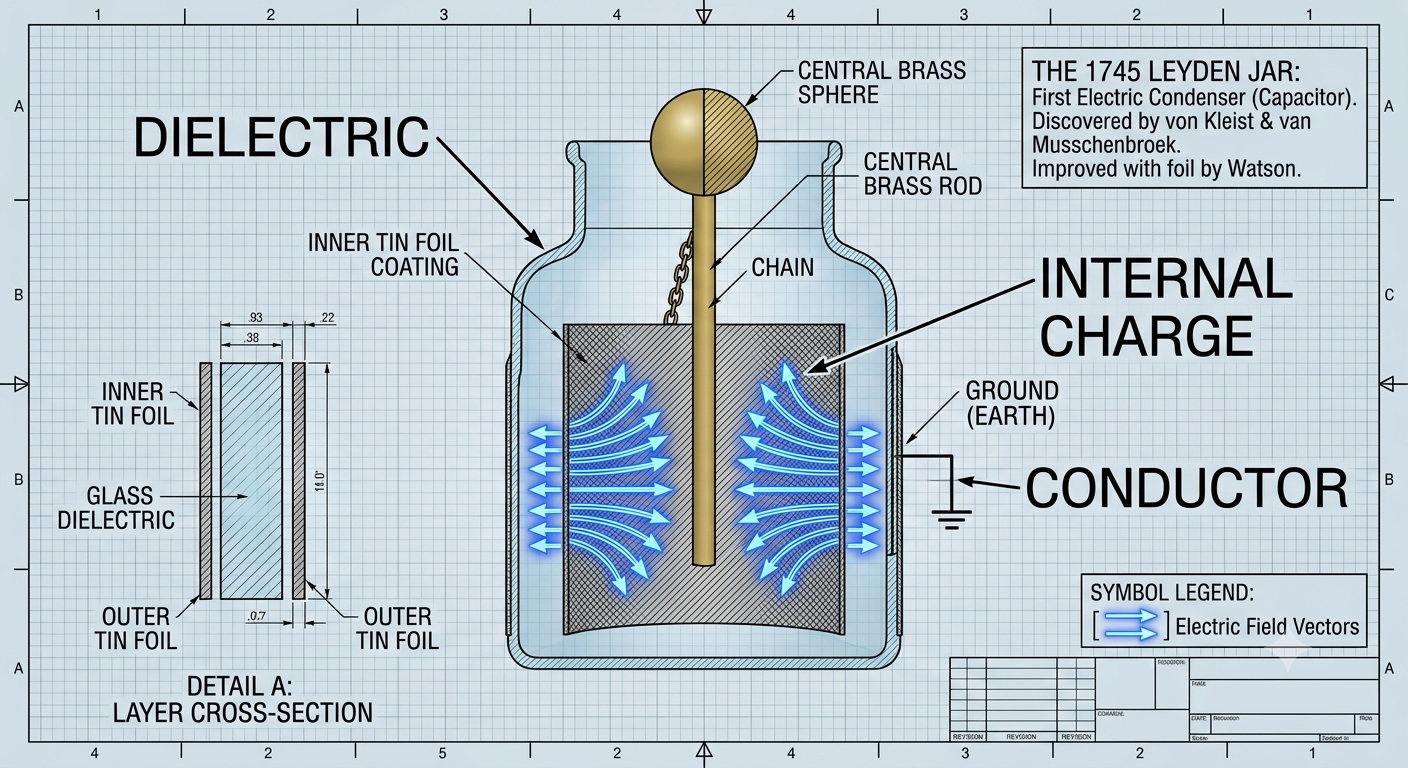
Yeh ek glass ka jar tha jiske andar aur bahar metal (tin foil) ki layering thi. Jar ke beech mein ek metal rod thi jo andar ke paani ya foil ko touch karti thi. Yeh duniya ka pehla Capacitor tha. Jab friction machine se static charge is rod ko diya jata, toh glass ke dielectric property ke karan heavy electrostatic charge store ho jata tha. Jab koi insaan is jar ki rod aur bahar ke foil ko ek sath touch karta, toh use ek bhayanak electric shock lagta tha. Isne prove kiya ki electricity ko ek jagah store kiya ja sakta hai.
1.4 Benjamin Franklin’s Dangerous Kite Experiment (1752)
1752 tak log sochte the ki aasmaan mein chamakne wali bijli (lightning) bhagwan ka prakop hai aur Leyden jar ki bijli kuch aur hai. American scientist Benjamin Franklin ne ise test karne ke liye apni jaan daav par laga di.
Unhone ek toofani raat (thunderstorm) mein ek silk ki patang udayi, jiske top par ek tikhna metal wire laga tha. Patang ki dori (string) hemp (bhang ke rase) ki thi jo geeli hone par conductor ban sakti thi. Dori ke sabse neeche ek silk ka ribbon bandha tha (jo unhone hath mein pakda tha takki shock na lage kyunki silk insulator hai) aur jahan dono jude the wahan unhone ek Metal Key (Chabi) baandh di. Jaise hi badal patang ke upar se guzre, hawa ke static charges dori se hote hue niche aaye. Jab Franklin ne apni ungli chabi ke paas le jayi, toh ek bada electric spark nikala aur unhone usse Leyden jar ko charge karke dikhaya.
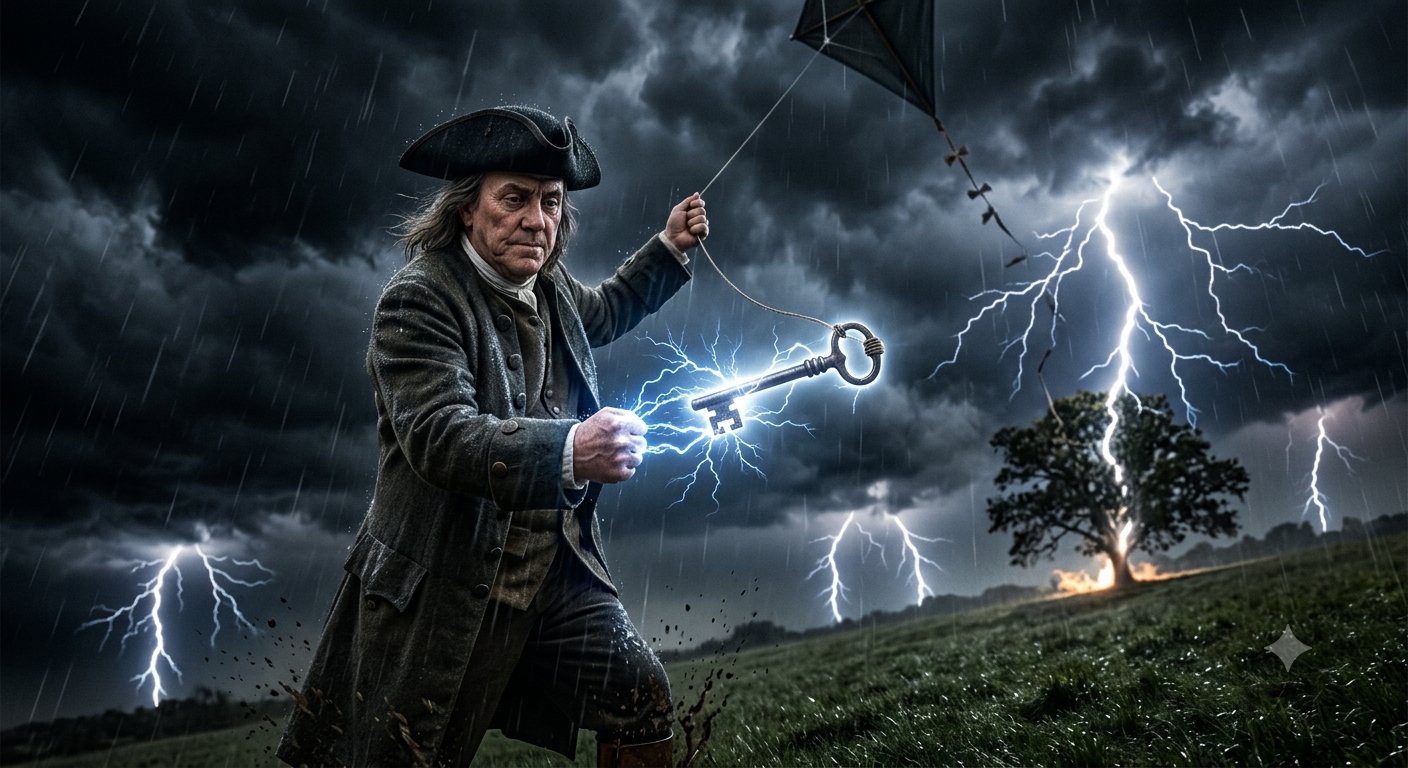
Problems Faced: Yeh experiment behad khatarnak tha. Agar bijli direct patang par gir jaati (direct lightning strike), toh Franklin wahi mar jaate. Baad mein jab Russian scientist Georg Wilhelm Richmann ne Saint Petersburg mein isi experiment ko dohrane ki koshish ki, toh ek ball lightning unke sir par lagi aur unki mauka-e-wardat par hi maut ho gayi.
CHAPTER 2: THE BIRTH OF INDUCTION (The Soul of AC Generator & Alternator)
2.1 The Galvani vs. Volta Debate (Animal Electricity vs. Chemical Action)
Static electricity sirf ek instant spark thi, isse aap koi fan ya bulb nahi chala sakte the kyunki electrons ek hi jhatke mein beh kar khatam ho jaate the. Hume zaroorat thi ek Continuous Current Flow ki. Iska rasta ek mare hue mendak (frog) se nikla.
1780s mein Italian anatomist Luigi Galvani apni lab mein ek mendak ki tang par research kar rahe the. Unhone dekha ki jab ek iron ke scalpel (chaaku) se frog ke nerve ko touch kiya gaya aur woh frog ek copper ke hook se latka tha, toh uski tangein tezi se phadphadane (twitch) lagti hain. Galvani ne conclude kiya ki animals ke muscles ke andar apni ek electricity hoti hai, jise unhone “Animal Electricity” ka naam diya.
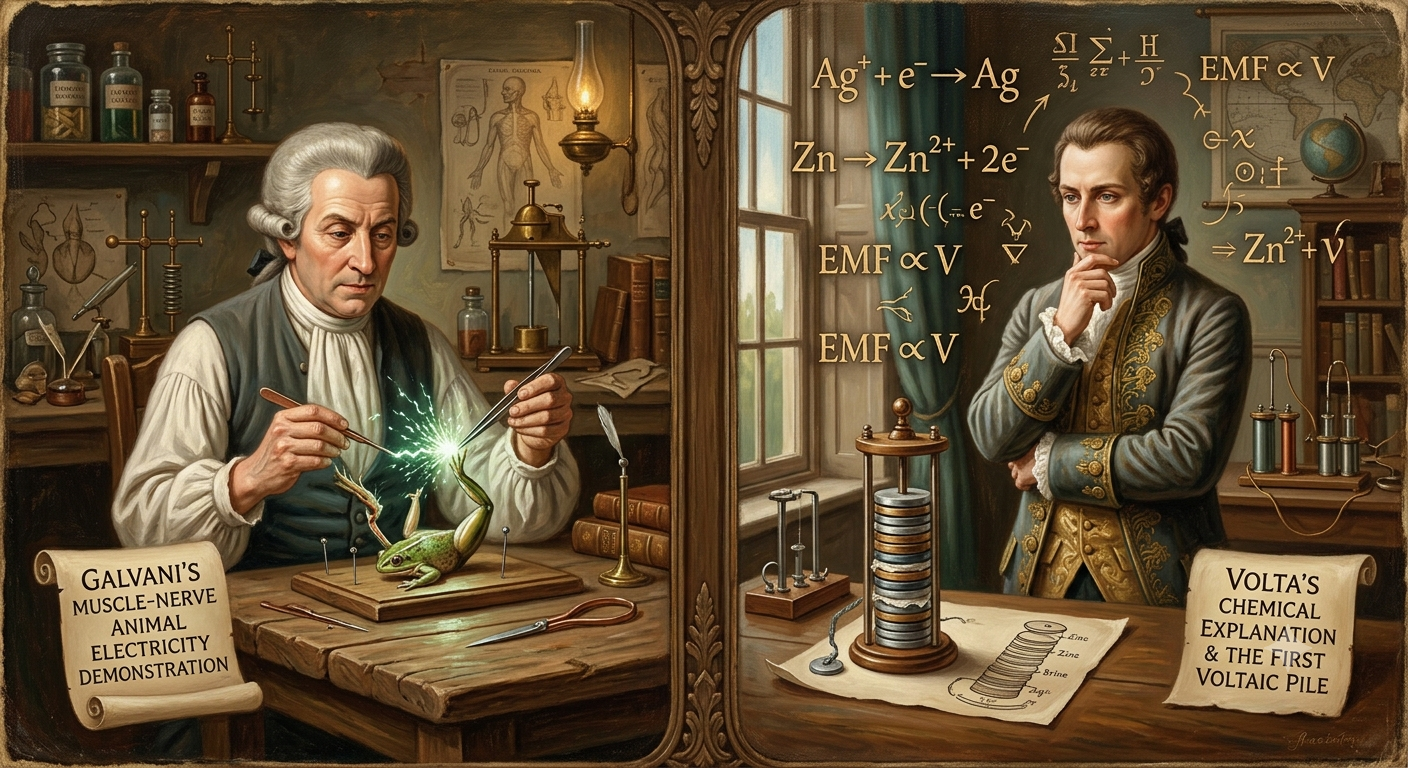
Lekin unke dost aur physicist Alessandro Volta ko is theory par shaq tha. Volta ne research ki aur prove kiya ki mehdak ke shareer mein koi bijli nahi thi. Mehdak ka gila shareer toh sirf ek Electrolyte (namkeen madhyam) ka kaam kar raha hai. Asli bijli toh un do alag-alag metals (Iron aur Copper) ke aapas mein contact aur chemical reaction ke karan ban rahi hai.
2.2 The Voltaic Pile (1800) – The Invention of Current
Is theory ko sahi prove karne ke liye Volta ne 1800 mein ek aisi cheez banayi jisne poori insaniyat ko badal diya—The Voltaic Pile. Yeh duniya ki pehli chemical battery thi.
Volta ne kya kiya:
- Unhone ek Zinc (Zn) ki disk li aur ek Copper (Cu) ki disk li.
- In dono ke beech mein unhone ek kapde ya cardboard ka tukda rakha jo namkeen paani (Brine / Electrolyte) mein bheegha hua tha.
- Unhone aise saikdon disks ko ek ke upar ek stack (gaddi) ke roop mein laga diya.
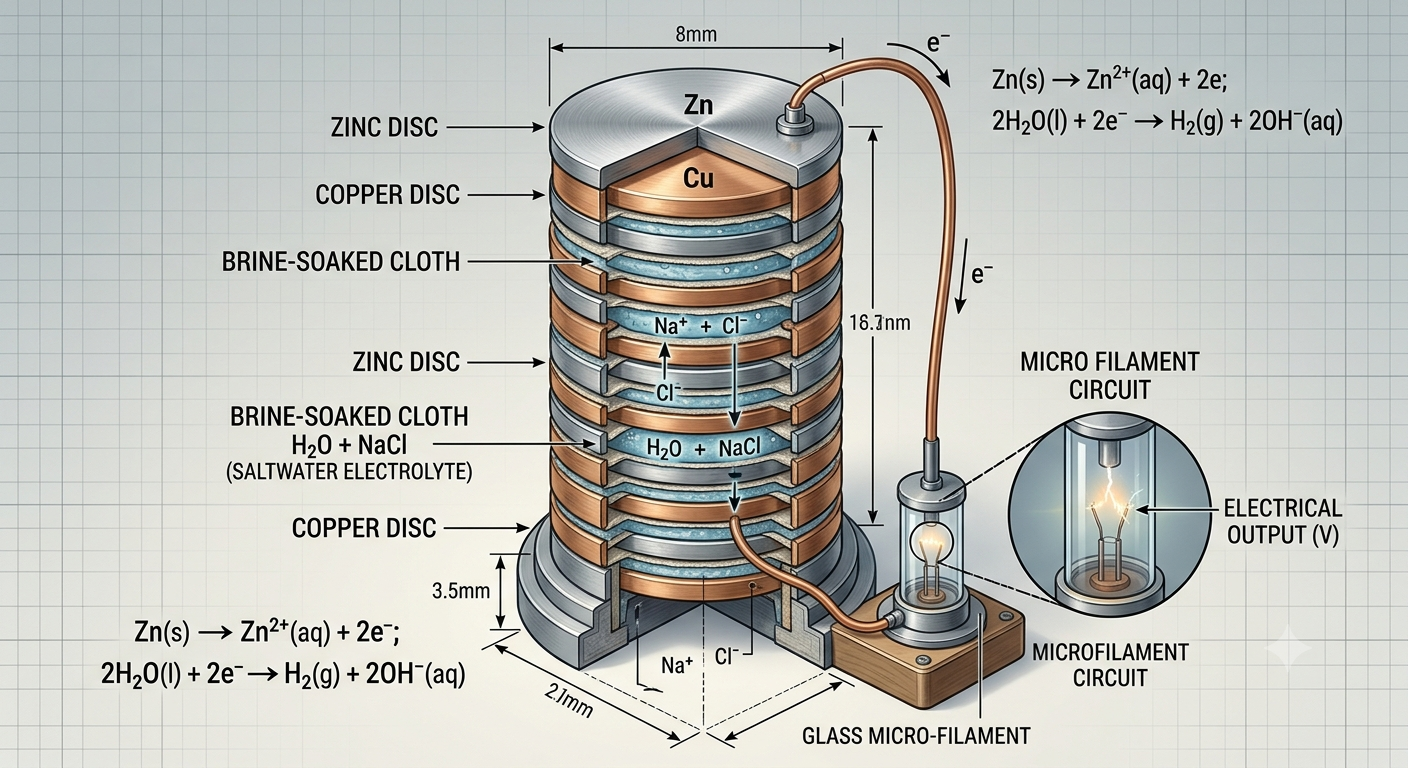
Jab unhone is pile ke sabse upar wale copper terminal aur sabse neeche wale zinc terminal ko ek wire se joda, toh us wire mein se lagatar electrons behne lage. Yeh duniya ka pehla continuous Direct Current (DC) tha.
CHAPTER 3: THE PRIMITIVE ELECTRICAL SYSTEMS (EARLY INDUSTRIAL ERA)
3.1 Oersted and Faraday: Converting Magnetism to Electricity
Volta ki battery se current toh mil gaya, par battery se poore shahar ko power nahi di ja sakti thi kyunki chemicals jaldi khatam ho jaate the aur unhe bar-bar badalna bohot mehanga tha. Hume chahiye tha mechanical energy se bijli banane ka tarika.
- Hans Christian Ørsted (1820): Unhone galti se dekha ki jab ek wire mein se electric current behta hai, toh uske paas rakhi magnetic compass ki needle hill jaati hai. Iska matlab tha ki Electricity se Magnetism paida hota hai.
- Michael Faraday (1831): Faraday ne socha agar electricity se magnetism ban sakta hai, toh kya Magnetism se Electricity nahi ban sakti?
Faraday ne ek copper wire ki coil banayi aur use ek Galvanometer (jo current detect karta hai) se jod diya. Jab unhone ek powerful Bar Magnet ko us coil ke andar aur bahar tezi se move kiya, toh galvanometer ki needle hili!
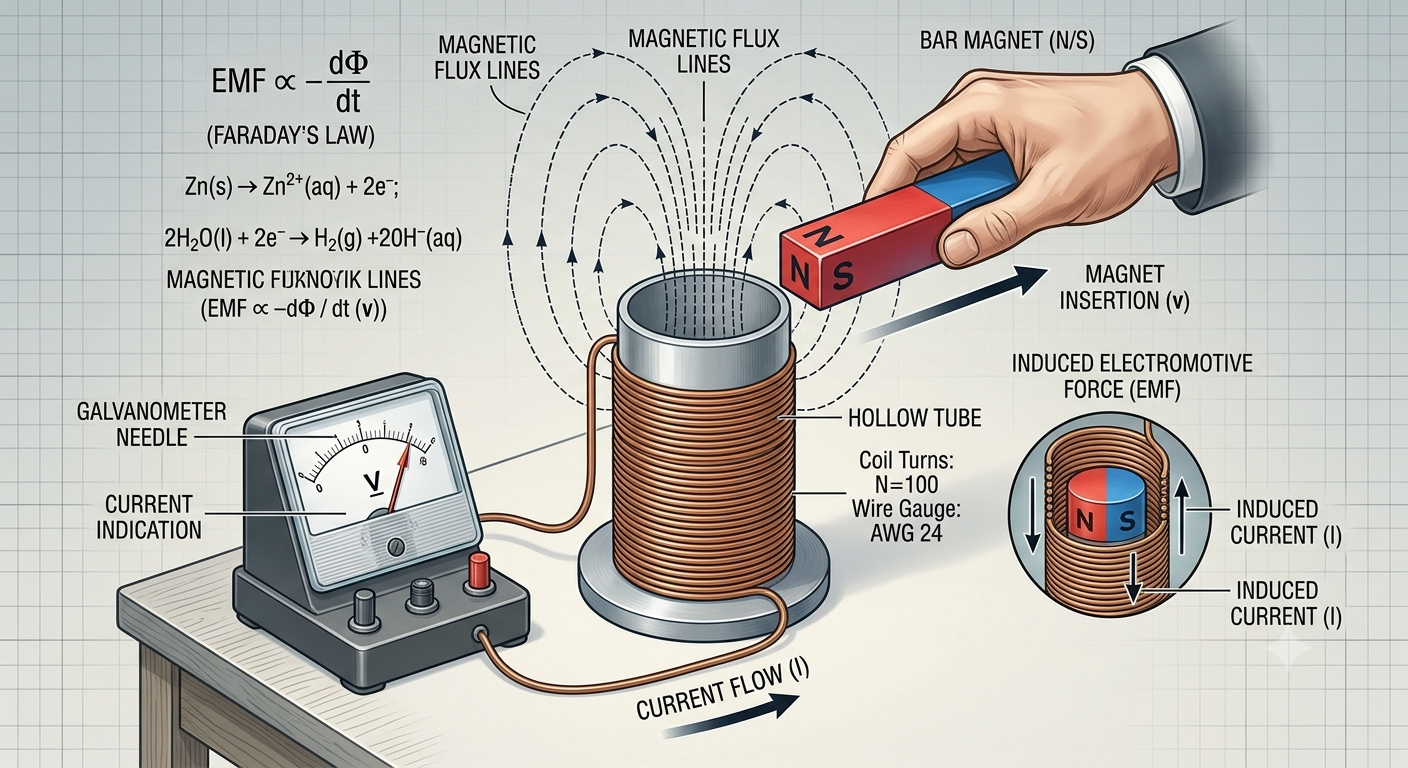
Faraday ne duniya ka sabse bada law diya: Electromagnetic Induction. Jab bhi kisi conductor se link hone wala Magnetic Flux samay ke sath badalta hai, toh us conductor mein ek Induced EMF (Electromotive Force) paida hota hai.
3.2 Thomas Edison’s Early DC Grid and Its Severe Problems
1880s tak aate-aate, Thomas Alva Edison ne New York mein Pearl Street Station khola, jo duniya ka pehla commercial power plant tha. Yeh system poori tarah se Direct Current (DC) par chalta tha. Isme bade-bade steam engines DC dynamos (generators) ko ghumate the aur 110V DC bijli banti thi.
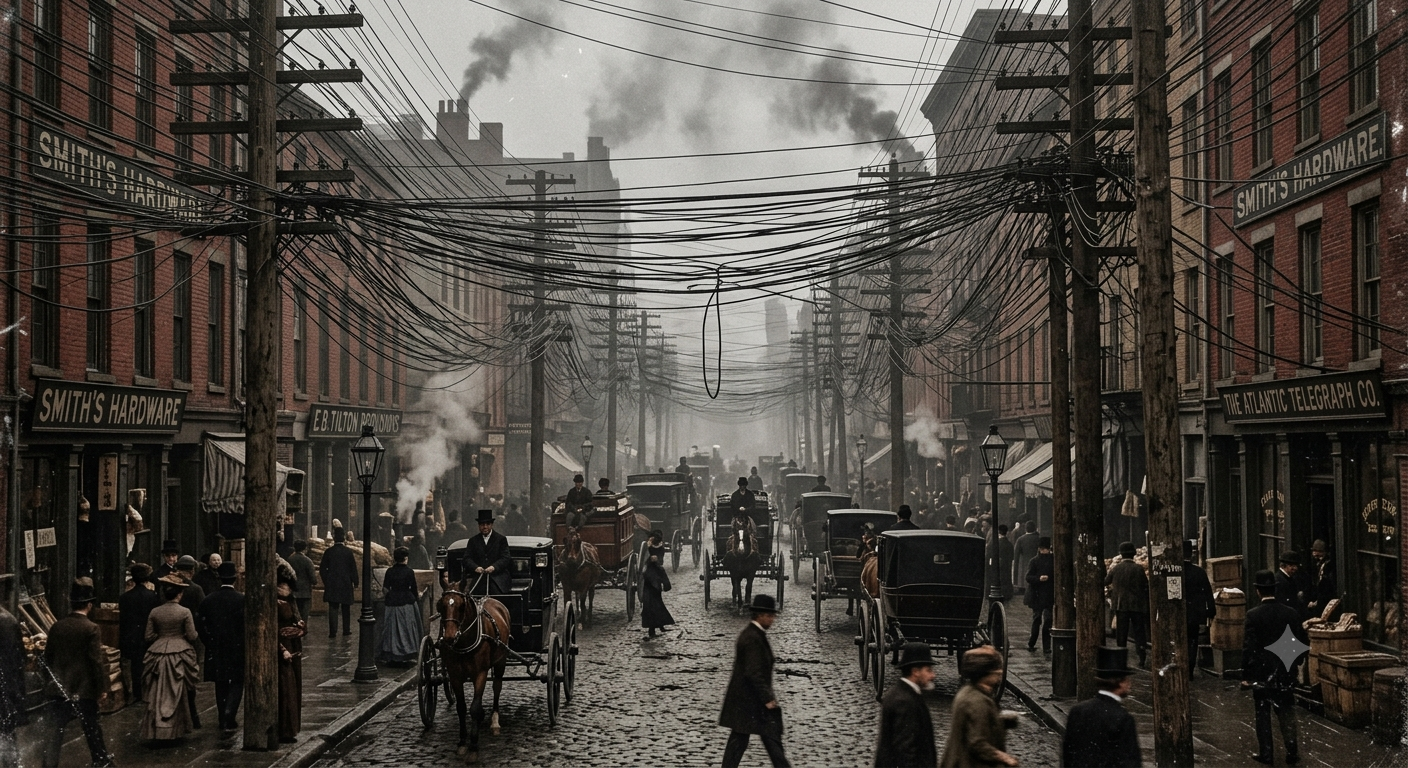
Lekin is primitive system mein aisi bhyankar kamiyan thin ki yeh poori tarah fail hone ki kagar par tha:
- The I2R Power Loss Problem: DC voltage ko us zamane mein badhaya ya ghataya (Step-up or Step-down) nahi ja sakta ke kyuki transformers sirf AC par kaam karte hain. Agar aapko 110V par chalne wale hazaron bulbs ko power bhejni hai, toh aapko wire mein bohot zyaada Current (
I) bhejna padega. - Power Loss Formula:
P_loss = I^2 * R - Kyunki current (
I) bohot high tha, isliye wires mein lagbhag saari bijli heat ban kar urr jaati thi. - The 1-Mile Distance Restriction: High losses ke karan Edison ki bijli generators se sirf 1 to 2 kilometers ki doori tak hi ja sakti thi. Iska matlab agar ek bade shahar ko bijli deni hai, toh har ek mile ke radius mein ek naya, dhuaan ugalne wala coal power plant lagana padta.
- Thick Copper Wires: Current itna zyaada tha ki patle taar pighal jaate the. New York ke aasmaan mein moti-moti copper ke cables ka jaal banna shuru ho gaya, jo kabhi bhi toot kar gir jaati thin.
CHAPTER 4: THE WAR OF CURRENTS (TESLA vs EDISON)
4.1 The Clash of Titans and Empires
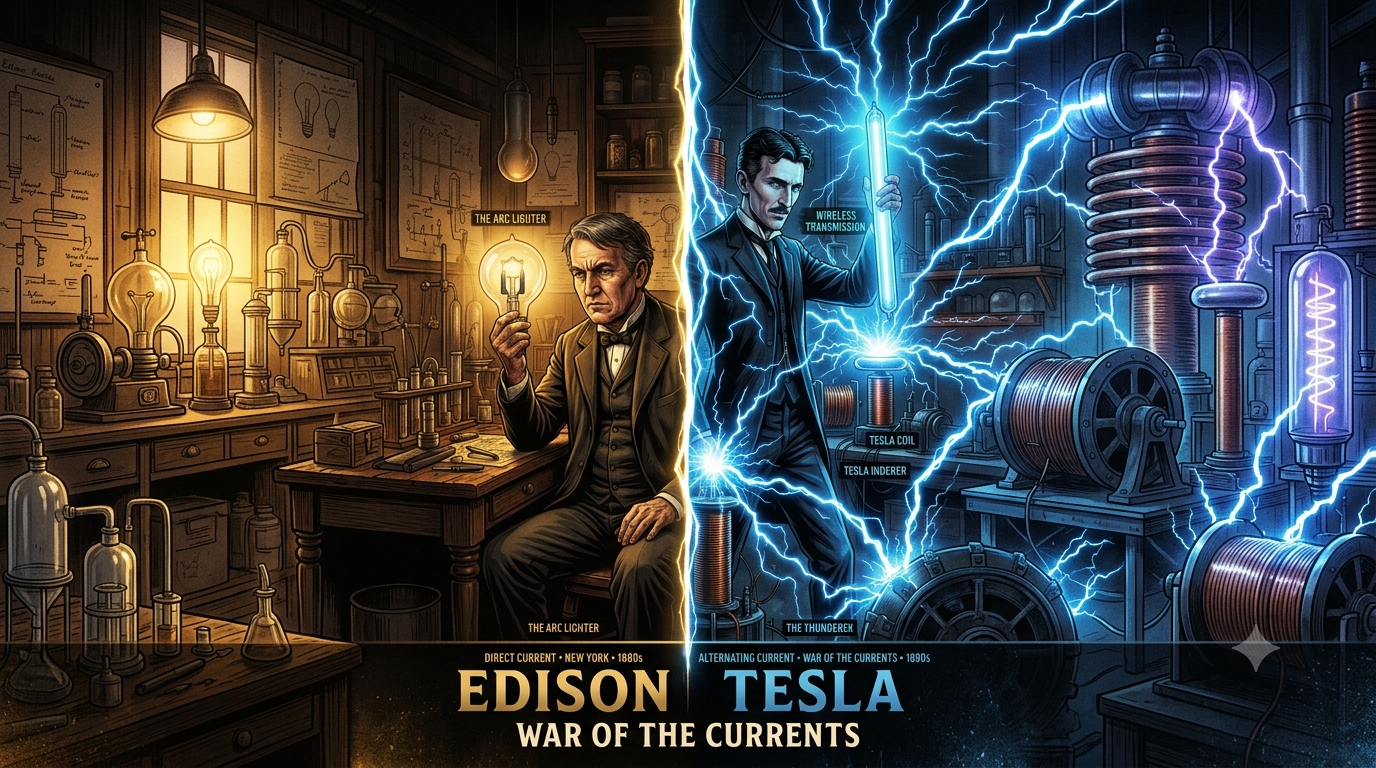
Yeh sirf do dimagon ki nahi, balki do alag business models aur physics ke fundamentals ki ladai thi.
- Thomas Edison (Edison Electric Light Co.): Unka poora business model DC patents par base tha. Unhone infrastructure mein lakhon dollars invest kar diye the, isliye woh kisi bhi haal mein DC ko harna nahi dekh sakte the.
- Nikola Tesla (George Westinghouse & Westinghouse Electric): Tesla ek Serbian engineer the jo Edison ke yahan hi kaam karne aaye the. Unhone Edison ko unke DC generators ki efficiency sudharne ka tarika diya, par jab Edison ne unhe unke promised 50,000 dollars dene se mana kar diya (yeh keh kar ki “Tesla, tum hamara American humor nahi samajhte”), toh Tesla ne job chhod di. Tesla ne apne Polyphase AC System aur Induction Motor ke patents George Westinghouse ko bech diye.
4.2 The Smear Campaign: Edison’s Dark Tactics
Tesla ka AC system transformes ka use karta tha. Yeh high voltage par electricity ko hazaron miles door bhej sakta tha aur destination par pahunch kar fir se safe 110V mein badal deta tha. Edison samajh gae ki AC unke DC business ko jadd se mita dega. Isliye unhone propaganda shuru kiya.
Edison ne public ke samne AC ko bhyankar aur jaanleva dikhane ke liye yeh sab kiya:
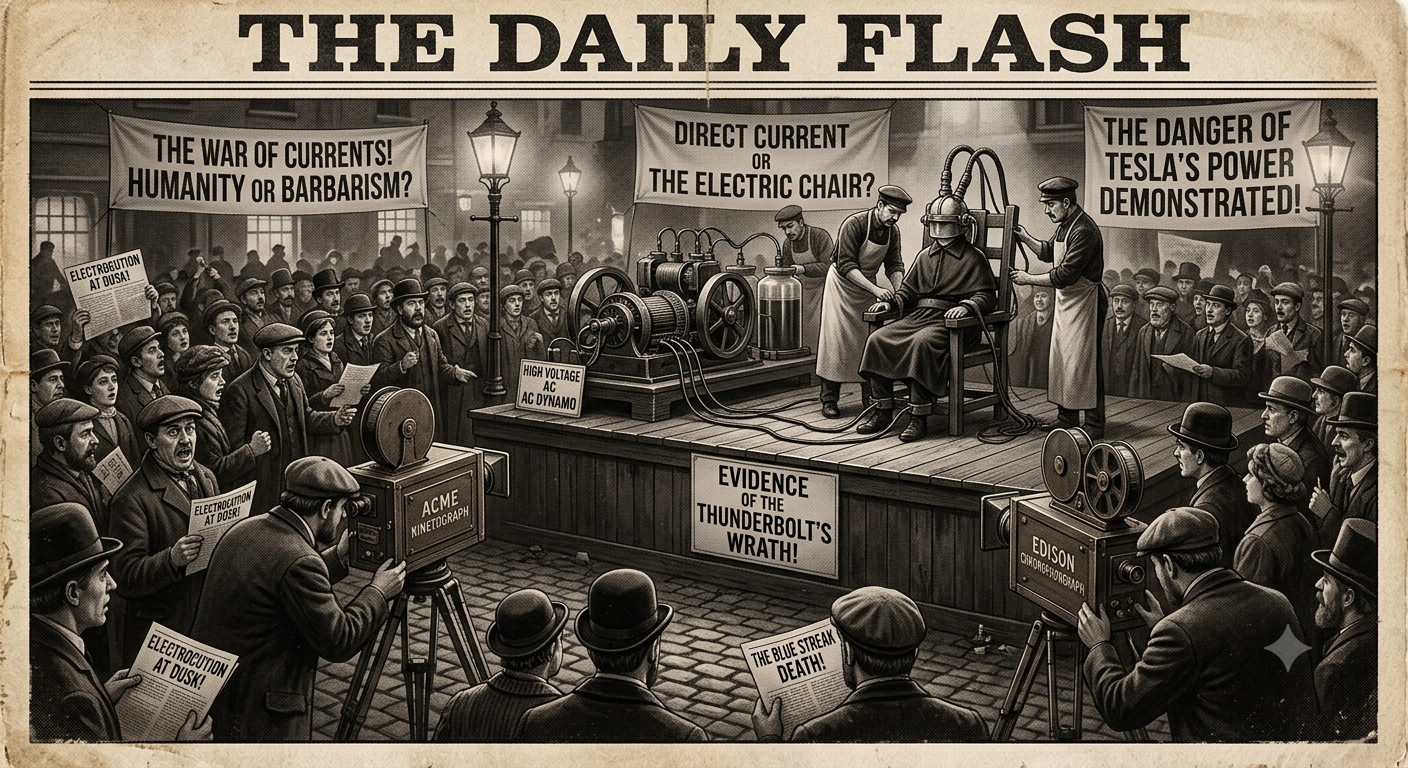
- Unhone awara kutton, billiyon aur keshon ko stage par lakar high-voltage AC current se electrocute (mar) diya.
- Unhone New York ke Coney Island par ek pagal haathi jiska naam Topsy tha, use sabke samne AC current dekar marwaya aur iska video banwaya.
- Unhone prison authority ke sath setting karke pehli Electric Chair banwayi jisme execution ke liye Westinghouse ke AC Generator & Alternator ka use kiya gaya, takki log AC current ko maut ka current samjhein aur gharon mein lane se darein.
4.3 The Mathematical Masterstroke of AC Transmission
Tesla ke AC system ki jeet ke peeche jo physics thi, use samajhna har engineer ke liye zaroori hai.
Man lijiye hume P amount ki electrical power ko kisi door jagah bhejni hai.
- Power Formula:
P = I * V(Power = Current * Voltage) - Power Loss Formula:
P_loss = I^2 * R
Tesla ne socha ki agar hum Voltage (V) ko 100 guna badha dein, toh same power bhejane ke liye Current (I) 100 guna kam ho jayega.
Agar Current 100 guna kam ho gaya, toh unka power loss kitna kam hoga?
(1/100)^2 = 1/10000
Yaani Power loss 10,000 guna kam ho jayega!
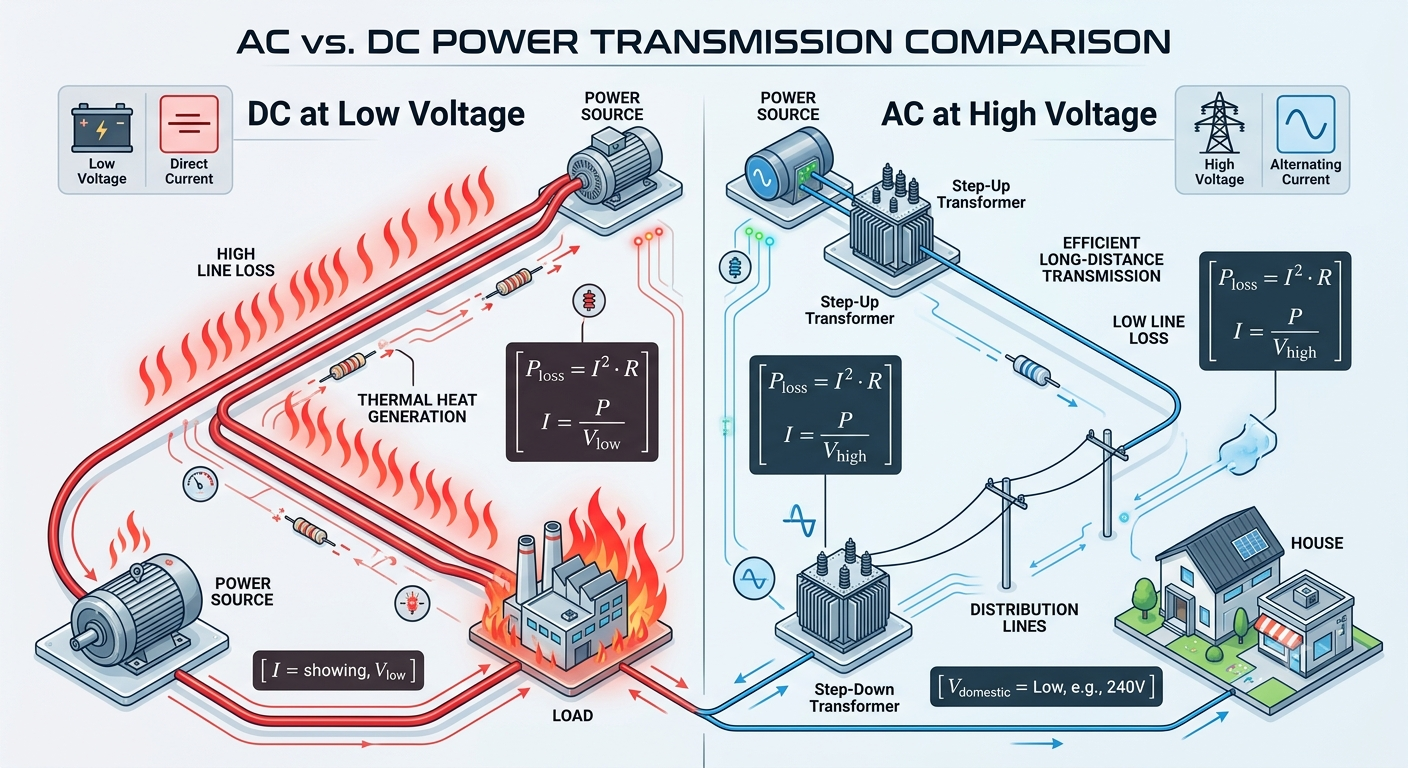
Is physics ke dum par AC ne DC ko hamesha ke liye piche chhod diya. 1893 ke Chicago World’s Fair mein Westinghouse ne Edison se aadhi keemat par poore mela ko light up karne ka contract le liya aur mela jab lakhon AC bulbs se ek sath chamka, toh War of Currents khatam ho gayi.
देखें: क्रिकेट पिच में इस्तेमाल होने वाली मिट्टी कहाँ से आती है? यहाँ क्लिक करें |
CHAPTER 5: THE EVOLUTION & ANATOMY OF ALTERNATORS
5.1 From Old Rotating Armature to New Rotating Field
Shuruaati generators mein design wahi hota tha jo hum DC motors mein dekhte hain: Rotating Armature Type.
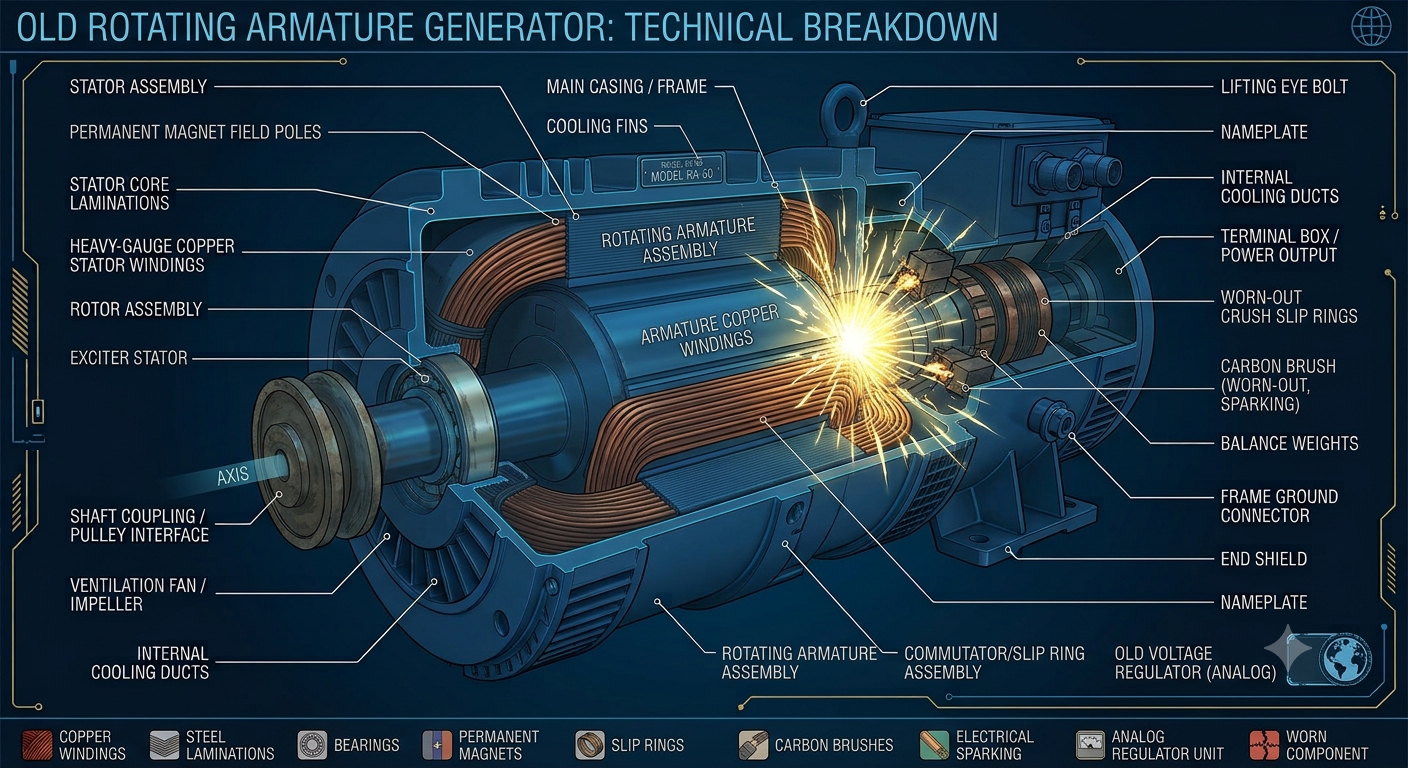
- Old Design Problems: Isme magnets stator (outer body) par fixed hote the, aur copper coil rotor (rotating shaft) par ghumti thi. Kyunki saari heavy current aur high voltage rotor ke andar paida ho rahi thi, isliye us current ko bahar nikalne ke liye badi-badi Slip Rings aur Carbon Brushes lagane padte the. Jab hazaron volts ka current ghumte hue rings se ghis kar guzarta tha, toh bhyankar sparking hoti thi, insulation fail ho jata tha, aur brushes har dusre din badalne padte the.
- The Modern Breakthrough (Rotating Field Type): Engineering ne is pure system ko ulta kar diya. Ab modern alternators mein Armature winding (Copper Coils) ko bahar Stator par permanently fix kar diya jata hai, aur Magnetic Field (Electromagnet) ko Rotor par rakh kar ghumaya jata hai.Advantage: Kyunki heavy power stator se seedhe, fixed terminal box ke raste bina kisi friction ke grid mein chali jaati hai, isliye slips rings ka load khatam ho gaya. Rotor ko magnet banane ke liye sirf ek bohot chhota sa DC voltage chahiye hota hai (Excitation Current), jise handle karna bohot aasan hai.
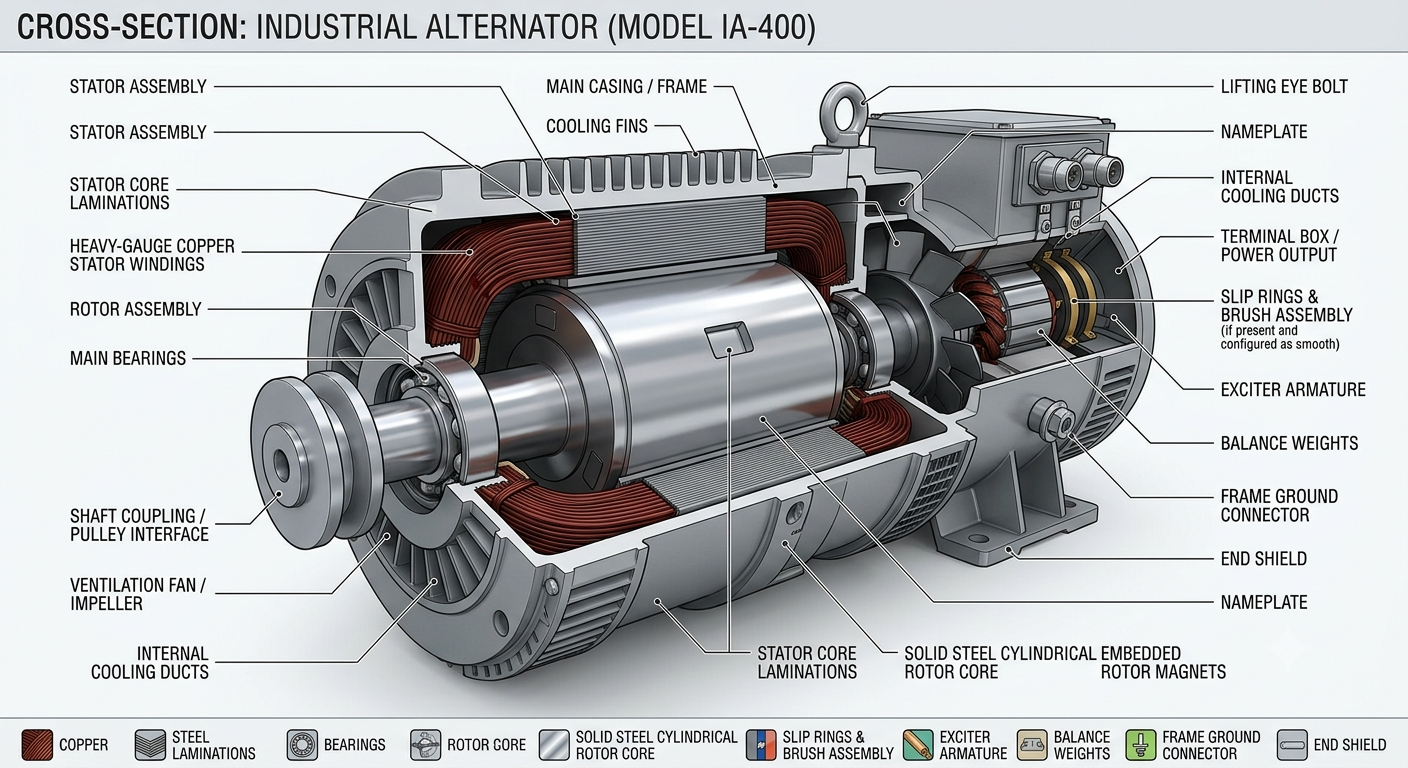
5.2 Core Mechanics of AC Generator & Alternator with Digital Excitation (The 2026 Standards)
Modern day industrial alternators completely automatic aur digital ho chuke hain. Inme do sabse advanced modules hote hain:
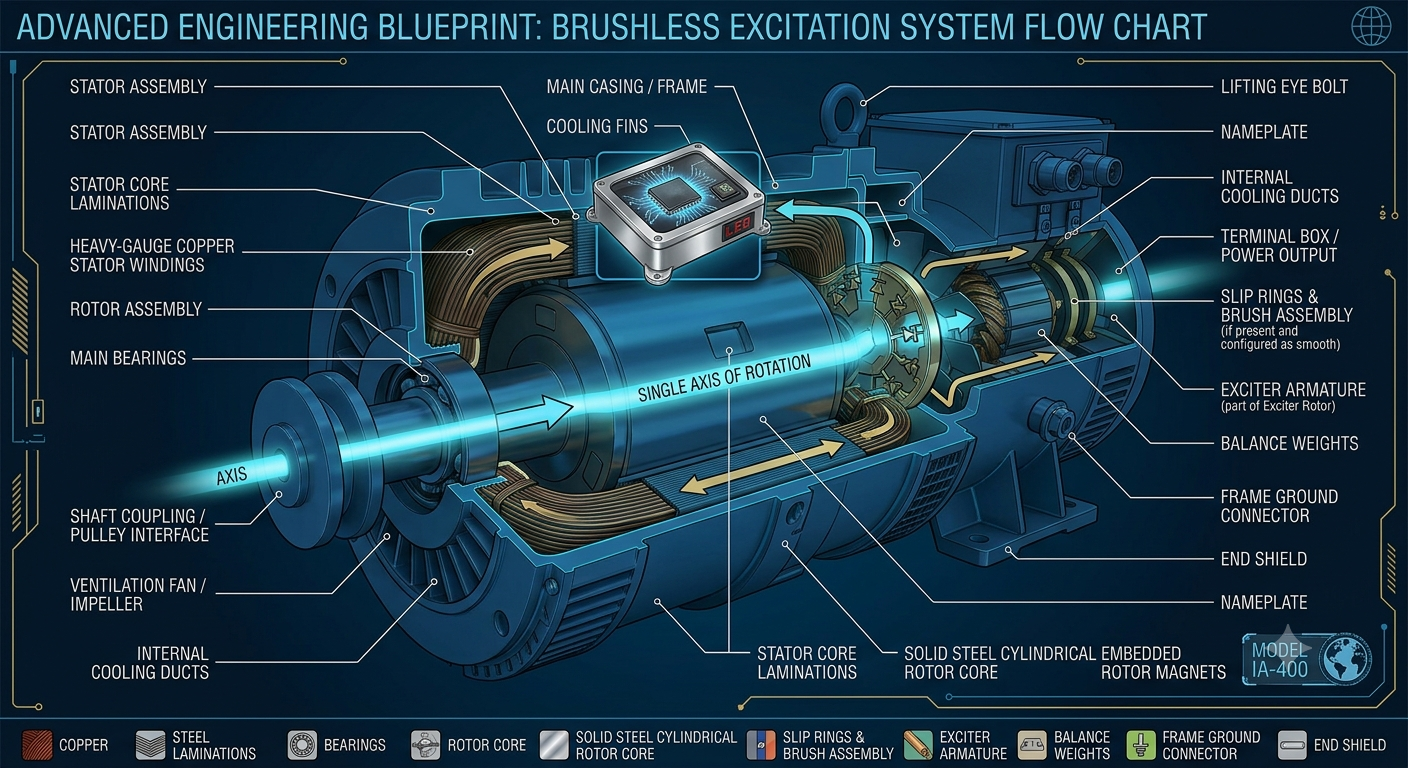
- Brushless Excitation System: Isme carbon brushes ka jhanjhat hi khatam kar diya gaya hai. Main rotor ke peeche shaft par ek chhota secondary generator lagaya jata hai jise Exciter kehte hain. Yeh rotation se AC banata hai, aur shaft par hi lage rotating Diode Bridge Rectifiers use instantly DC mein convert karke main rotor coil ko de dete hain. Mechanical touch zero ho jata hai.
- dAVR (Digital Automatic Voltage Regulator): Purane zamane mein jab factory mein heavy machine chalu hoti thi, toh voltage ek dam se drop ho jata tha jisse bulbs dim ho jaate the. Aaj ke modular alternators mein digital microprocessors hote hain. Jaise hi load badhta hai, dAVR microsecond ke andar rotor ki magnetic strength badha deta hai, jisse output voltage hamesha stable rehta hai.
5.3 Classification: Types of AC Generator & Alternator
Engineers alternators ko unke dynamic mechanics ke aadhar par do bade types mein baant-te hain:
Type A: Salient Pole Rotor Alternator
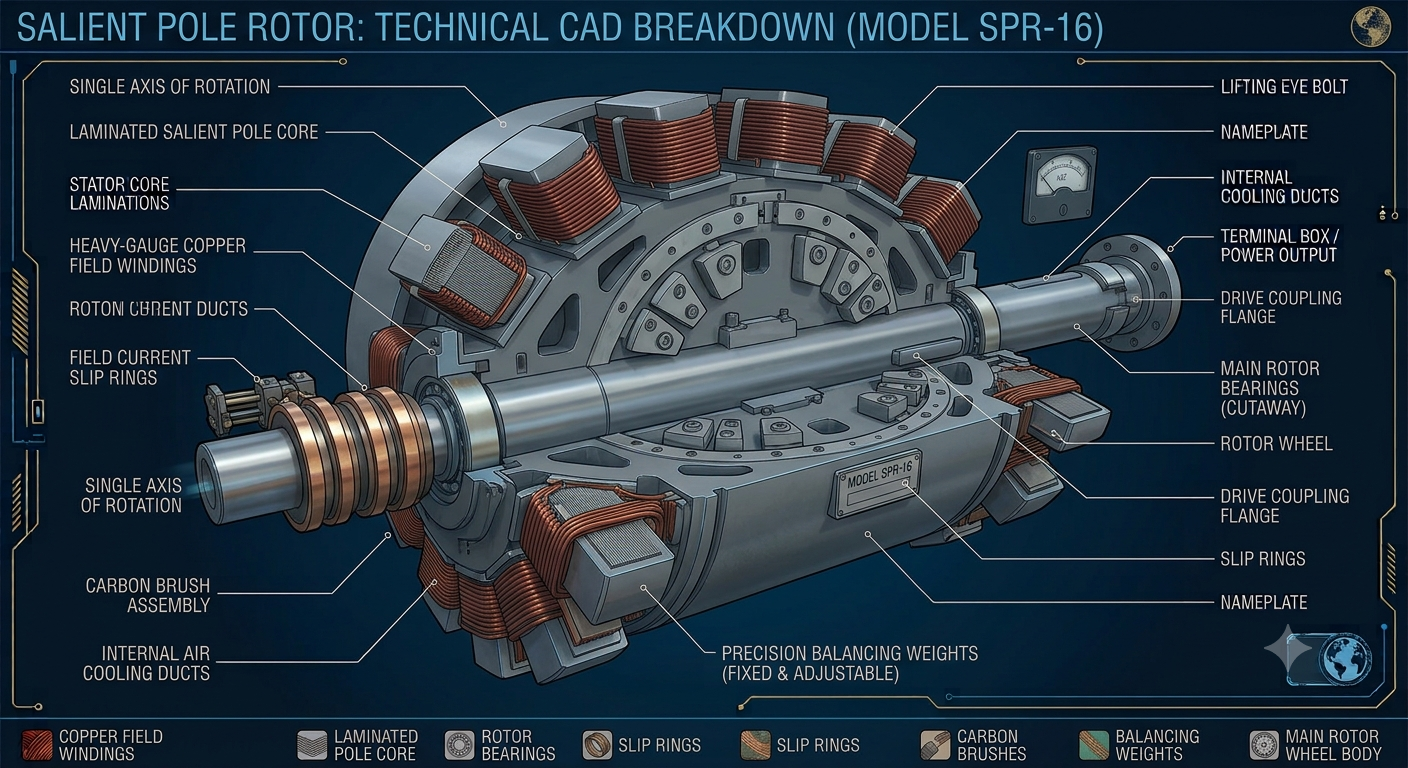
- Design: Iske poles bahar ki taraf nikle hue (projected) hote hain, jaise kisi wheel par spokes lage hon. Iska diameter bohot bada hota hai par axial length (lambai) kam hoti hai.
- Speed: Yeh bohot dhere ghumte hain (125 to 500 RPM). Kyunki speed kam hoti hai, isliye frequency (50 Hz) maintain karne ke liye isme poles ki sankhya (P) badhani padti hai (aksar 20 se 40 poles).
- Application: Inka use Hydroelectric Power Plants (paani ke dams) mein hota hai jahan turbine paani ke pressure se dhere ghumti hai.
Type B: Cylindrical (Non-Salient) Rotor Alternator
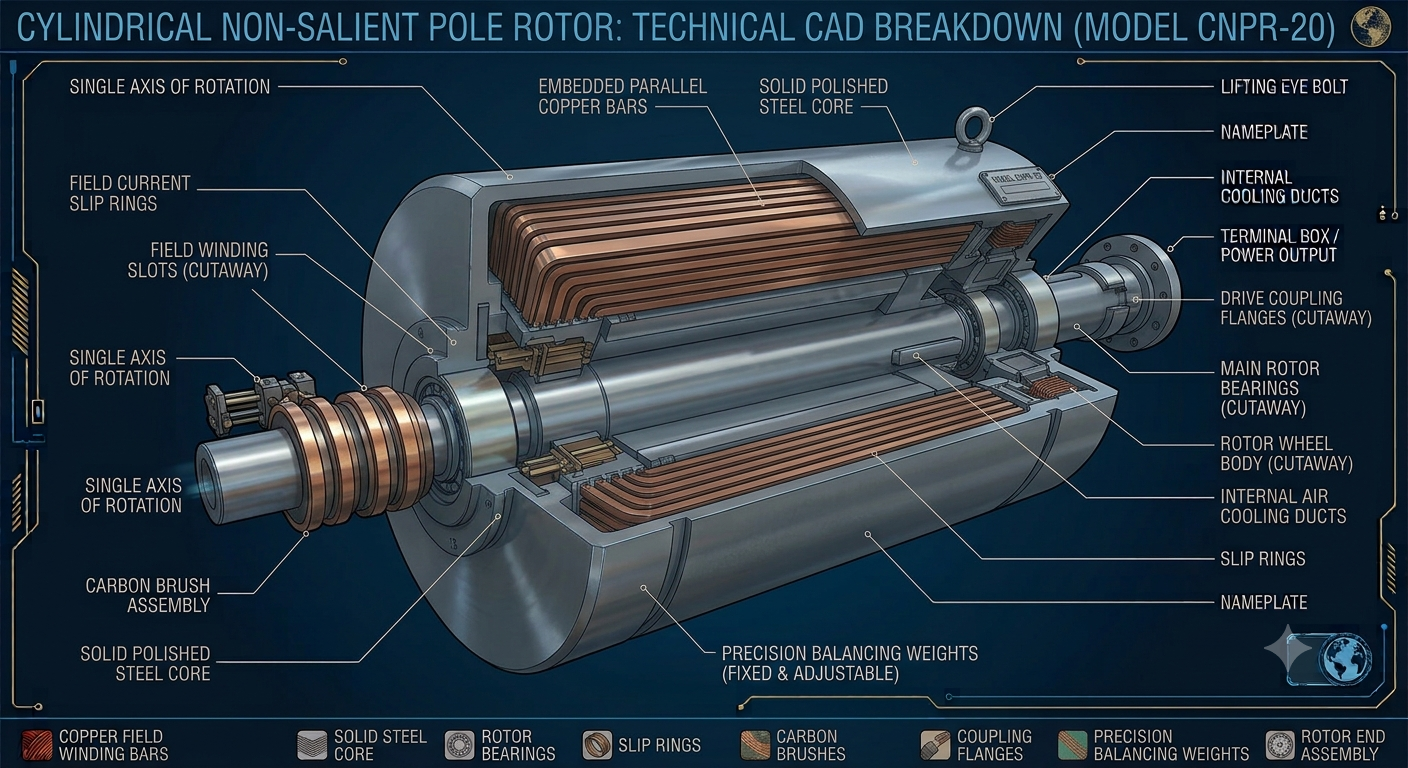
- Design: Yeh rotor bilkul smooth, solid aur gol steel cylinder jaisa hota hai. Iska diameter kam hota hai par axial length bohot zyaada hoti hai takki high centrifugal force mein tute nahi.
- Speed: Yeh bhyankar tezi se ghumte hain (1500 to 3000 RPM). Poles ki sankhya bohot kam hoti hai (sirf 4 ya 2 poles).
- Application: Inka use Thermal aur Nuclear Power Plants mein hota hai jahan high-pressure steam turbines inhe super speed par ghumati hain. Inhe Turbo-Generators bhi kehte hain.
CHAPTER 6: FORMULA DEEP-DIVE & MATHEMATICAL CALCULATIONS
Aaiye ab un mathematical formulas ko samajhte hain jinpar har electrical power system design kiya jata hai.
6.1 Alternator Speed and Frequency Calculation
Kisi bhi alternator ke andar Frequency, Poles, aur Rotation Speed ke beech ka relation is formula se nikala jata hai:
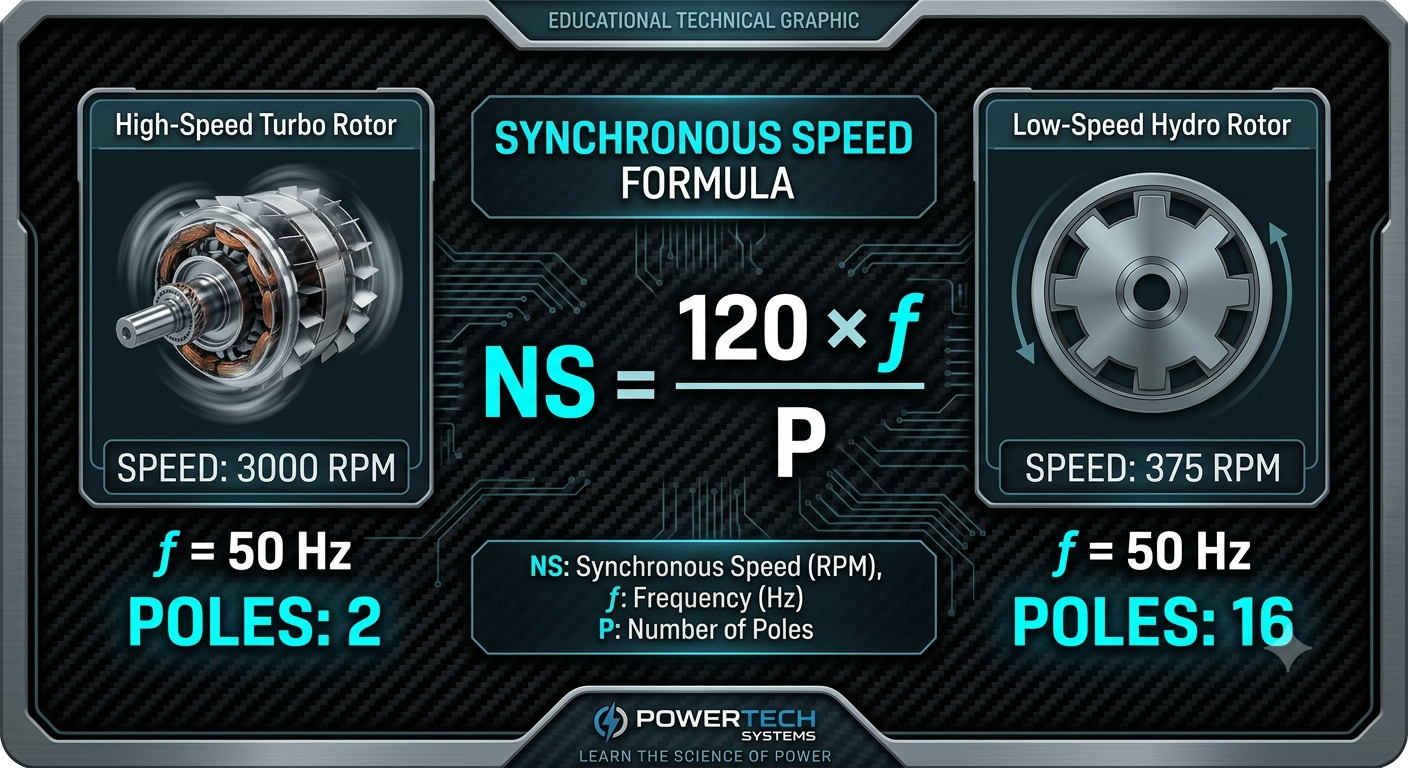
Speed (NS) = (120 * f) / P
Yahan:
NS= Synchronous Speed (Rotations Per Minute – RPM)f= Frequency (Hertz – Hz mein, jo India mein hamesha 50 Hz hoti hai)P= Total Number of Magnetic Poles
Agar aapko kisi motor ya generator ka Pole nikalna ho jab aapko uski speed pata ho, toh formula is tarah badal jata hai:
P = (120 * f) / NS
Practical Engineering Case Study: Maan lijiye aapko ek Hydro plant ke liye generator design karna hai jo 375 RPM par ghumega, aur hume Bharat ke grid ke liye 50 Hz ki bijli chahiye. Us generator mein kitne poles lagane honge?
- Calculation:
P = (120 * 50) / 375 = 6000 / 375 = 16 Poles - Iska matlab us alternator mein hume 16 poles ka salient rotor lagana padega.
6.2 Induced EMF Equation of an Alternator
Alternator ke stator winding mein kitne volts paida honge, use is comprehensive engineering equation se nikala jata hai:
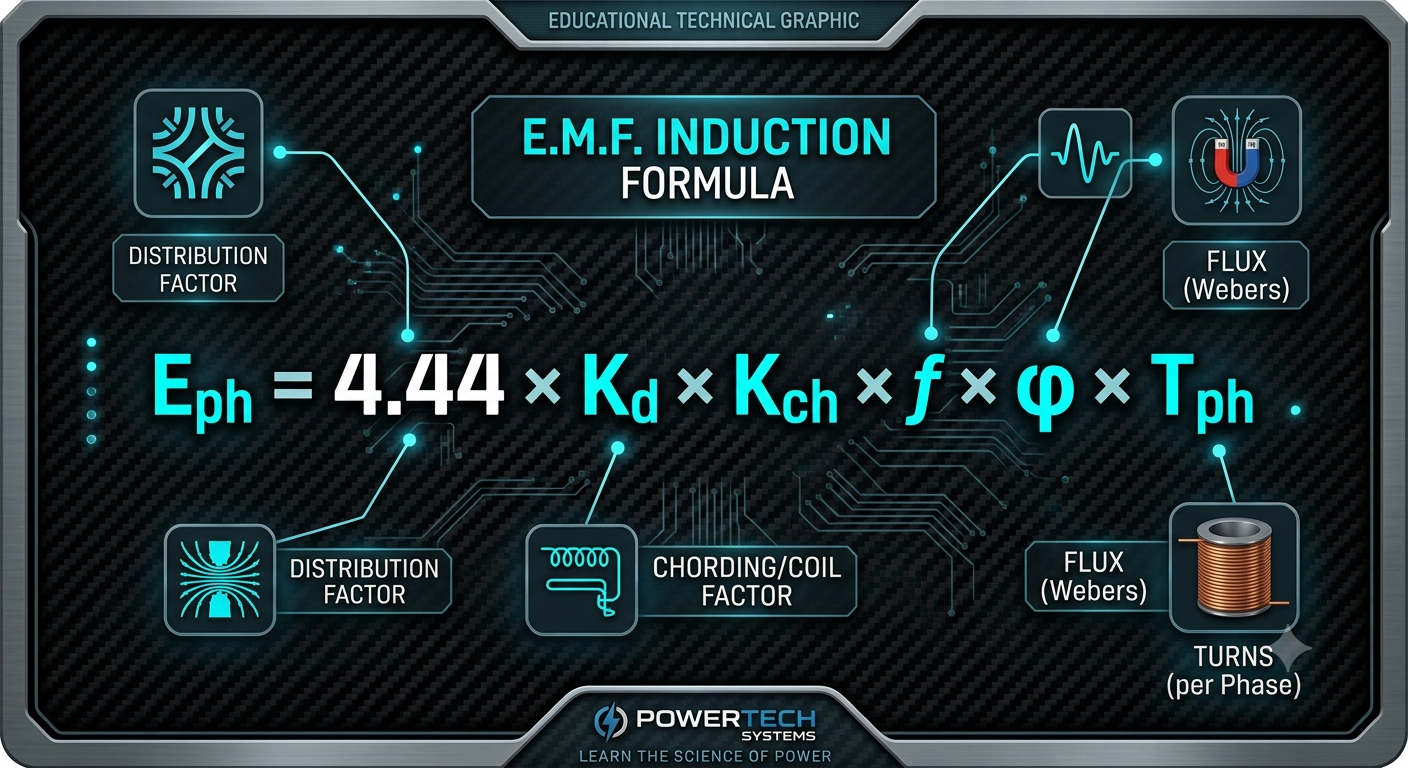
E_ph = 4.44 * K_d * K_ch * f * phi * T_ph
Yahan:
E_ph= Induced RMS Voltage per phaseK_d= Distribution Factor (Windings ko stator par kaise spread kiya gaya hai)K_ch= Pitch Factor / Chording Factor (Coil short-pitch hai ya full-pitch)f= Frequency (50 Hz)phi= Magnetic Flux per pole (Weber mein)T_ph= Number of turns in series per phase
Engineering mein K_d aur K_ch ki value hamesha 1 se thodi kam (jaise 0.95-0.98) hoti hai, kyunki slots mein windings perfectly uniform nahi hoti, jisse harmonics khatam ho sakein aur hume pure Sine Wave electricity mile.
CHAPTER 7: ADVANCED CORE SCIENTIFIC PROCESS OF POWER GENERATION IN AC Generator & Alternator
Bijli alag-alag sources se kaise banti hai, uski poori physical aur thermodynamic cycle yahan deep engineering levels par di gayi hai.
7.1 Nuclear Energy to Electricity Process in AC Generator & Alternator (The Quantum to Kinectic Cycle)
Nuclear plants koyla nahi jalate, balki atoms ko todte hain. Iske peeche Einstein ki mass-energy equivalence equation kaam karti hai.
Step 1: Controlled Chain Reaction in Core
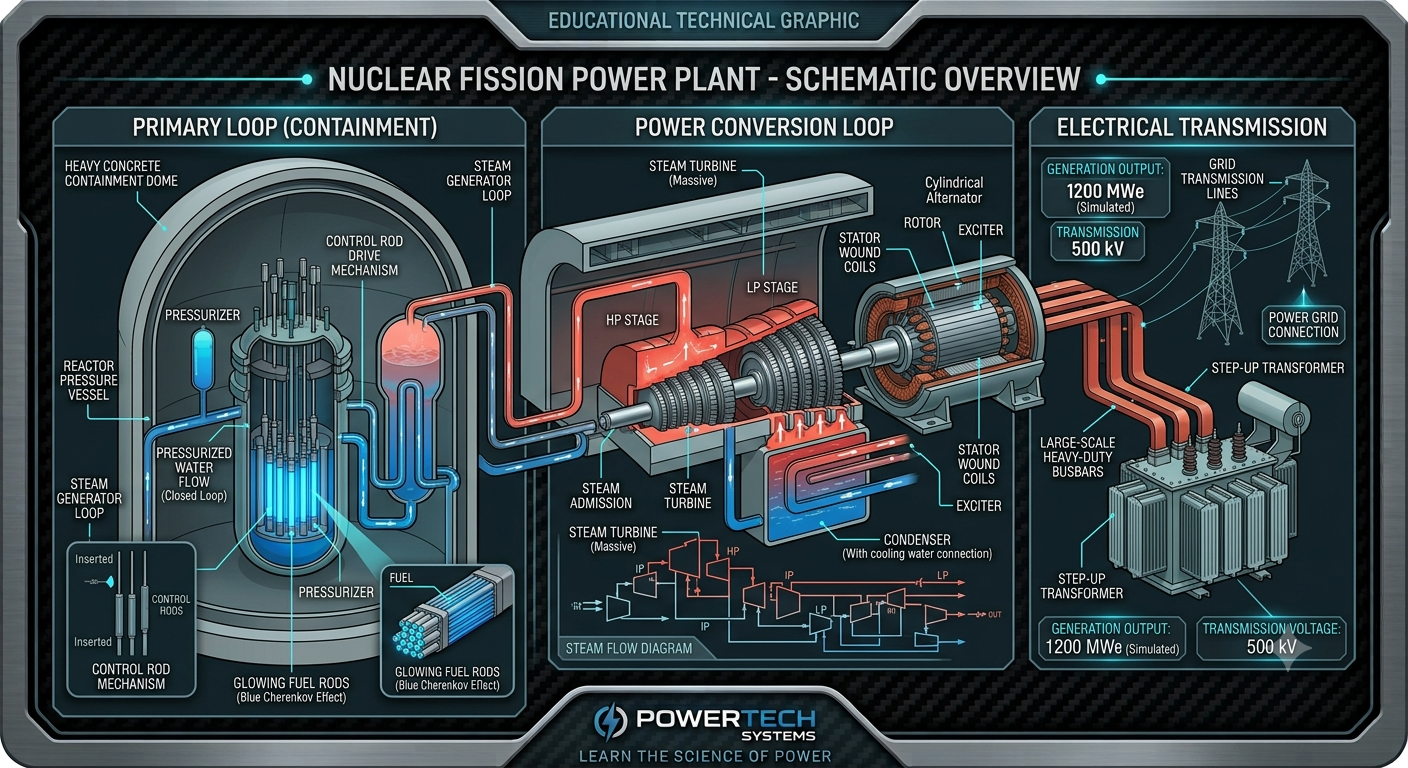
Reactor core ke andar Uranium-235 ki rods hoti hain. Jab ek slow neutron Uranium nucleus par hit karta hai, toh woh unstable hokar do naye atoms (Barium-141 aur Krypton-92) mein toot jata hai, aur sath mein 3 naye high-speed neutrons aur prachand matra mein Binding Energy (Heat) nikalta hai.
- Scientific Reaction Chain:
U-235 + n -> Ba-141 + Kr-92 + 3n + Heat Energy (~200 Million Electron Volts)
Step 2: Heat Transfer and Steam Loops
Yeh heat reactor ke Primary Coolant Loop (Paani ya Liquid Sodium) mein jaati hai. Yeh paani 150 bar se zyaada pressure par hota hai, isliye yeh 300∘C par bhi bhaap (Steam) ban kar ubalta nahi hai. Yeh primary water Steam Generator ke contact mein aakar secondary loop ke paani ko bhaap (Steam) me badal deta hai.
Step 3: High-Speed Cylindrical Turbine Rotation
Yeh dry, superheated steam high velocity se Cylindrical Turbo-Alternator ke blades par takrati hai. Turbine ghumti hai, aur generator ka 2-pole rotor 3000 RPM par rotate karke direct Three-Phase AC Electricity grid mein pump kar deta hai.
7.2 Advanced Aerodynamics of Wind Energy
Hawa se bijli banana sirf ek pankha ghumana nahi hai, yeh fluid dynamics ka ek joda hai.
Step 1: Lift vs Drag Principle
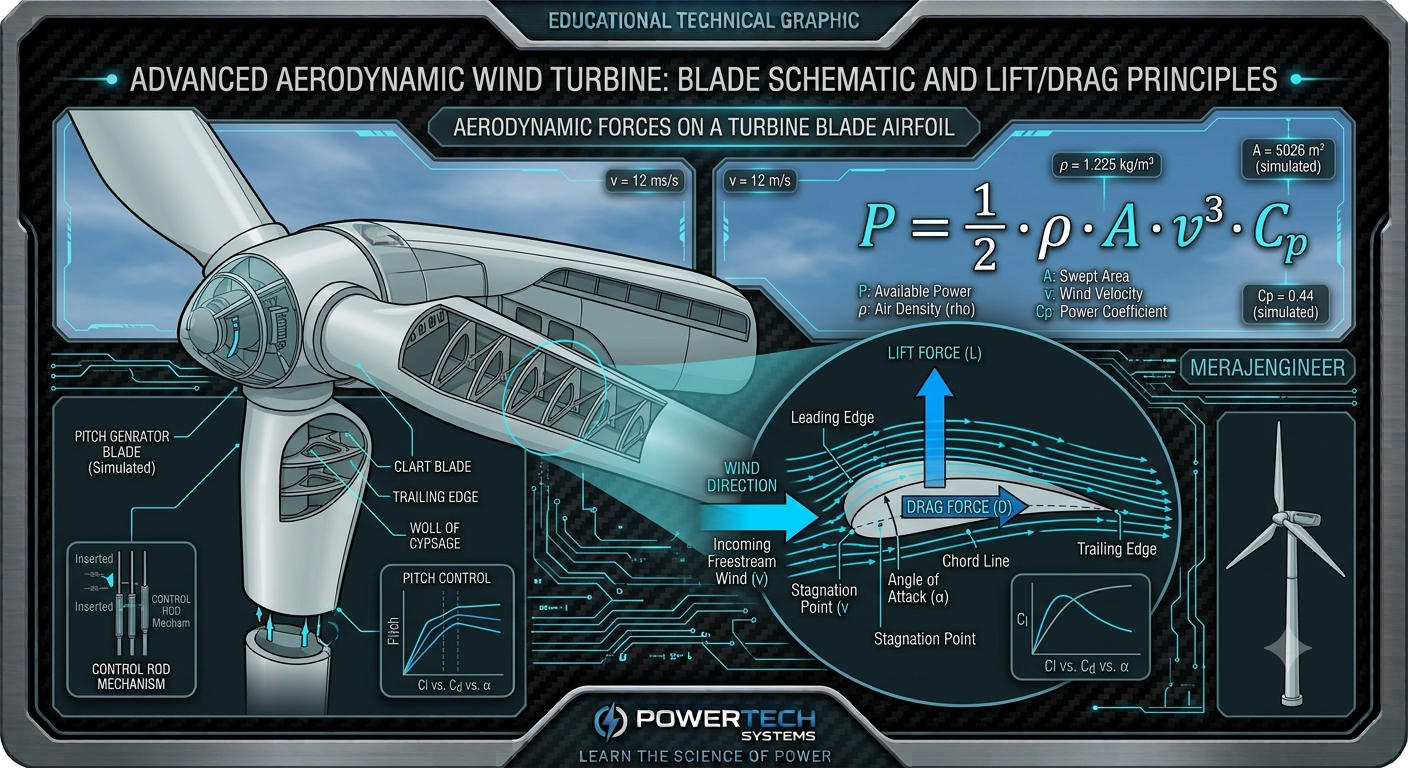
Wind turbine ke blades ka cross-section ek hawai jahaj ke pankh jaisa (Airfoil Shape) hota hai. Jab hawa blade ke upar aur niche se guzarti hai, toh upper surface par low pressure aur lower surface par high pressure banta hai. Is differential pressure se ek Lift Force paida hota hai jo blade ko ghumata hai, jabki drag force use rokne ki koshish karta hai.
Step 2: The Betz Limit of Wind Energy
Physics ka ek strict niyam hai jise Betz’s Law kehte hain. Koi bhi wind turbine hawa ki kinetic energy ka 59.3% se zyaada hissa electricity mein convert nahi kar sakti.
- Wind Power Governing Formula:
P_wind = 0.5 * rho * A * v^3 * Cp - Yahan
rho= Air Density,A= Rotor Swept Area (Blades kitne bade ghere mein ghum rahe hain),v= Wind Speed, aurCp= Coefficient of Performance (Maximum 0.593).
Step 3: Dynamic Frequency Match via DFIG
Kyunki hawa ki raftaar badalti rehti hai, turbine ke RPM bhi badalte rehte hain. Grid ko fix 50 Hz dene ke liye modern wind turbines mein DFIG (Doubly-Fed Induction Generator) laga hota hai, jo rotor winding ko inverter ke raste alag frequency ka current dekar output frequency ko hamesha 50 Hz par lock rakhta hai.
CHAPTER 8: GEOPOLITICS OF POWER & INDIA’S STRATEGIC DOMINANCE
8.1 The Continental Interconnected Grids
Electricity ko store karna duniya ka sabse mushkil kaam hai, isliye use bante hi bechna padta hai. Is wajah se deshon ne aapas mein transmission lines jodkar giant grids bana liye hain.
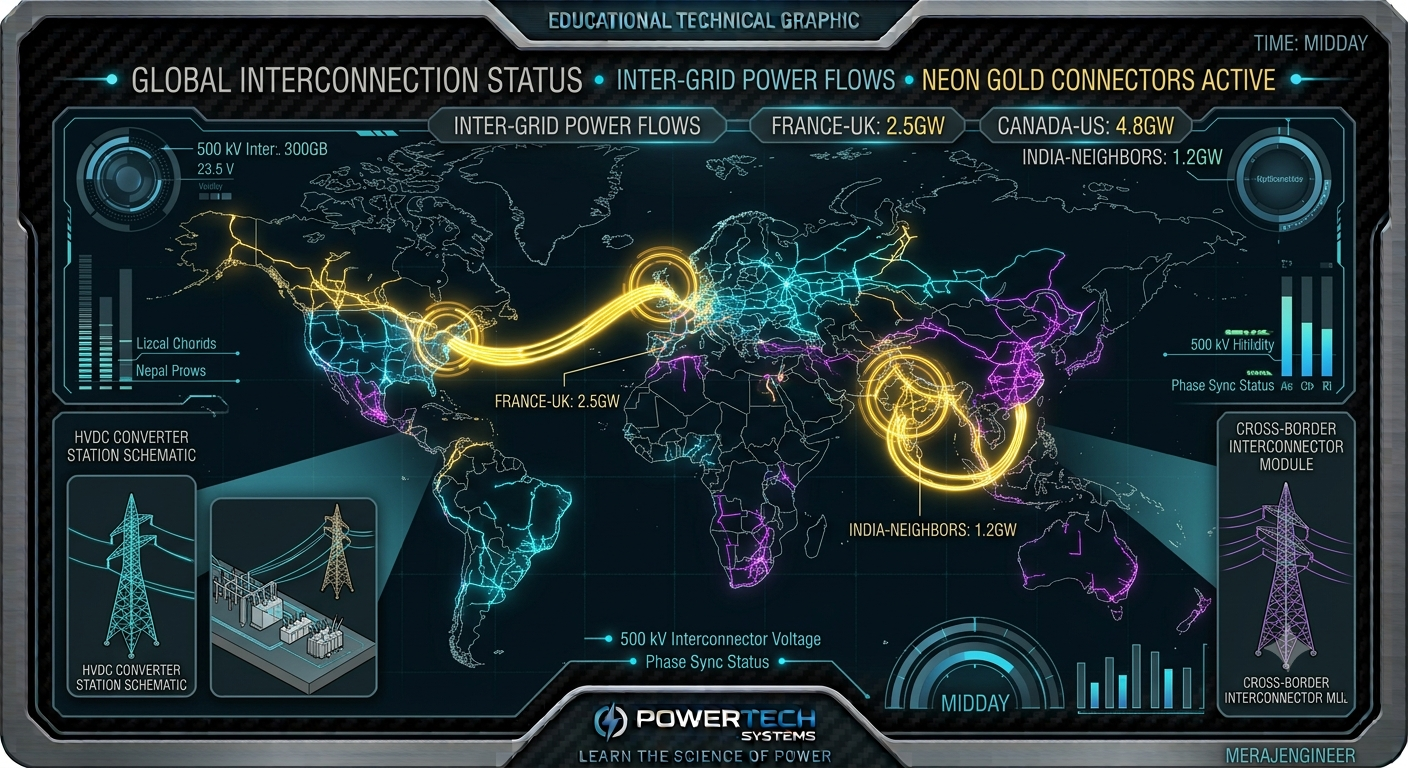
- The ENTSO-E Euro Grid: Europe ka grid sabse advanced hai. France ke paas 50 se zyaada nuclear reactors hain, isliye jab uske paas sasti extra electricity hoti hai, toh woh use under-sea cables ke raste United Kingdom, Italy, aur Germany ko bech deta hai. Jab Germany mein hawa nahi chalti aur unke wind plants band hote hain, toh woh France se nuclear power import karte hain. Norway apne pahadi deshon ke bade reservoirs se paani chodkar Hydro-power banata hai aur subsea lines se poore Europe ko balance karta hai.
- The African Rift Grid & ASEAN Grid: Laos ne apne saare nadiyaon par dams banakar khud ko “The Battery of Southeast Asia” ghoshit kar diya hai, jo apni lagbhag saari bijli Thailand aur Vietnam ko supply karta hai.
8.2 India’s Geopolitical Masterstroke: “One Nation, One Grid, One Frequency”
Pehle India alag-alag regional grids (North, South, East, West) mein banta tha, jisse agar North mein shortage ho toh South ki extra bijli wahan nahi bheji ja sakti thi. December 2013 mein Southern Grid ko Central Grid se connect karne ke baad India ka grid duniya ke sabse bade Synchronous Grids mein shamil ho gaya.
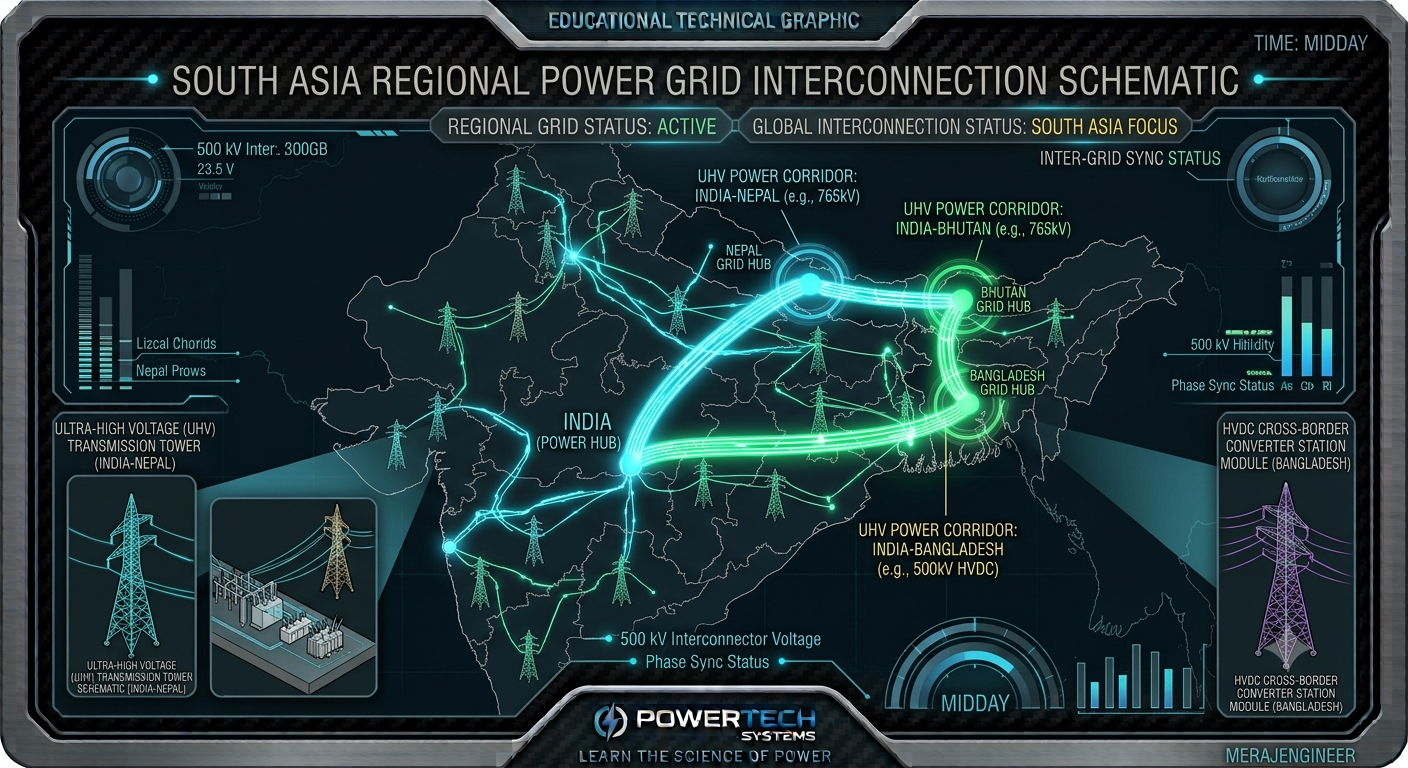
India ka cross-border electricity business (CBET) ab poore South Asia ko chala raha hai:
- Bangladesh Power Export: India apne state grids aur Adani Power ke exclusive Ultra-supercritical thermal plant (Godda, Jharkhand) se 1600+ MegaWatt high-voltage DC lines ke zariya seedhe Bangladesh ko electricity supply karta hai.
- The Nepal & Bhutan Dynamic Exchange: Bhutan aur Nepal pahadi desh hain. Jab garmiyon aur monsoon mein unki nadiyaan ufaan par hoti hain, toh unke hydro plants full chalte hain. India us samay unse sasti green electricity Import karta hai. Jab thandiyon mein unka paani barf ban kar jam jata hai, toh unke power houses band ho jaate hain. Us dauran India apne National Grid se unhe electricity Export karta hai takki wahan blackout na ho.
- The Trilateral Route: India ne Nepal ko permission di hai ki woh India ke transmission corridors ka use karke apni hydro-electricity Bangladesh ko bech sake. Isse India is pure region ka ultimate energy broker aur leader ban gaya hai.
Conclusion
Invention ke us static shock se lekar modern synchronous multi-nation power grids tak, AC Generator & Alternator ki engineering hi hamari modern civilization ki reedh ki haddi (backbone) hai. Isliye, ek engineer ke liye alternator sirf copper aur iron ka dhabba nahi, balki Faraday aur Tesla ke dimag ka ek zinda chamatkar hai jo poori duniya ko roshan kiye hue hai.
Disclaimer: The information provided in this blog post is for educational and informational purposes only. While every effort has been made to ensure the accuracy of the technical facts, historical data, and engineering formulas, technology and sciences evolve continuously. This content should not be treated as professional engineering advice or an official textbook alternative. The website or the author shall not be held liable for any direct or indirect consequences arising from the practical application of this information. For any real-world projects or practical applications, please consult certified professionals and official standards.
For Official Scientific & Historical Verification:
- About the fundamental principles of electricity and electromagnetism. NASA Science – Electromagnetism Guide. 👈 Click Here
- Mathematical laws governing generators and alternating current, explore the professional journals on the IEEE Xplore Digital Library. 👈 Click Here
- About the history of the War of Currents (Tesla vs. Edison) officially archived at the Smithsonian Institution. 👈 Click Here
धन्यवाद 🙏 ThanksYou